
A play-based relational wellbeing program for children
A different starting point for wellbeing.
Children learn an enormous amount about the world as they grow up. But they don't always get many opportunities to become curious about what happens inside themselves, or what happens between them and other people.
Common Ground is a play-based wellbeing program designed to give children those opportunities.
Rather than teaching children the "right" way to feel, or a set of rules for managing difficult emotions, Common Ground provides an opportunity for them to organically notice themselves more accurately, understand their reactions with curiosity rather than judgement, make room for other people's experiences, and discover that they have choices about what they do next. And over time, these discoveries become skills.
While self-awareness and socio-emotional skills can be developed individually, capacities such as perspective-taking, relational awareness, tolerance of difference, personal responsibility and remaining grounded in one’s own experience must be practiced in relationship with other people.
The group setting gives children a real social environment in which to discover and develop these skills.
These are the type of subtle skills that lay underneath many other social and emotional skills, and shape every relationship that follows.
What it looks like for children.
Not much like a psychology lesson.
For children, Common Ground looks much more like games, movement, imagination, detective work, laughter and experiments.
They might walk around the room embodying ridiculous imaginary characters, invent what a grumpy turtle desperately needs, experiment with body posture, work in pairs or groups, draw, move, talk and occasionally stop for a moment to notice what just happened.
They might experiment with how different “parts” of themselves show up in different situations, investigate what happens when an environment changes, discover how differently a room full of people can experience the same thing, or try to uncover the “hidden mission” behind a game
Some activities are deliberately silly.
Others might unexpectedly show a child something interesting about themselves or somebody else.
Personal or vulnerable disclosure is never required and children will not be pressured to share private or vulnerable experiences with the group. Activities frequently use age appropriate fictional characters, playful scenarios and group experiments so children can explore psychological and relational ideas safely.
There are no right answers. The aim is for discoveries to emerge through experience rather than children simply being told how they should think, feel or behave.
What Common Ground aims to develop.
One of the ideas we explore is that we all have different sides, or "parts", of ourselves. There might be a confident part, an angry part, a worried part, a bossy part, a shy part, a silly part, or a part that really wants everyone to like us. None of these parts make someone "good" or "bad". Instead, children learn to get curious:
When does this part show up?
What happens in my body?
What might it be trying to do?
What might it need?
Instead of simply thinking:
"I'm shy,"
a child might begin to notice:
"My shy part comes out in some situations, but not others."
That small change creates room for curiosity and flexibility rather than turning a momentary experience into a fixed idea about who they are.
Children also experiment with noticing somebody else's experience without immediately needing to:
Agree with it
Fix it
Compete with it
Judge it
Shrink in response to it
Defend themselves against it
So, instead of:
"He made me angry, so I yelled at him,"
there can gradually be a little more space for:
"I noticed I got really angry when he did that. What is happening in me? What do I want to do now?"
That little bit of space between reacting and choosing can become pivotal in friendships, disagreements, classrooms, family life, and beyond.
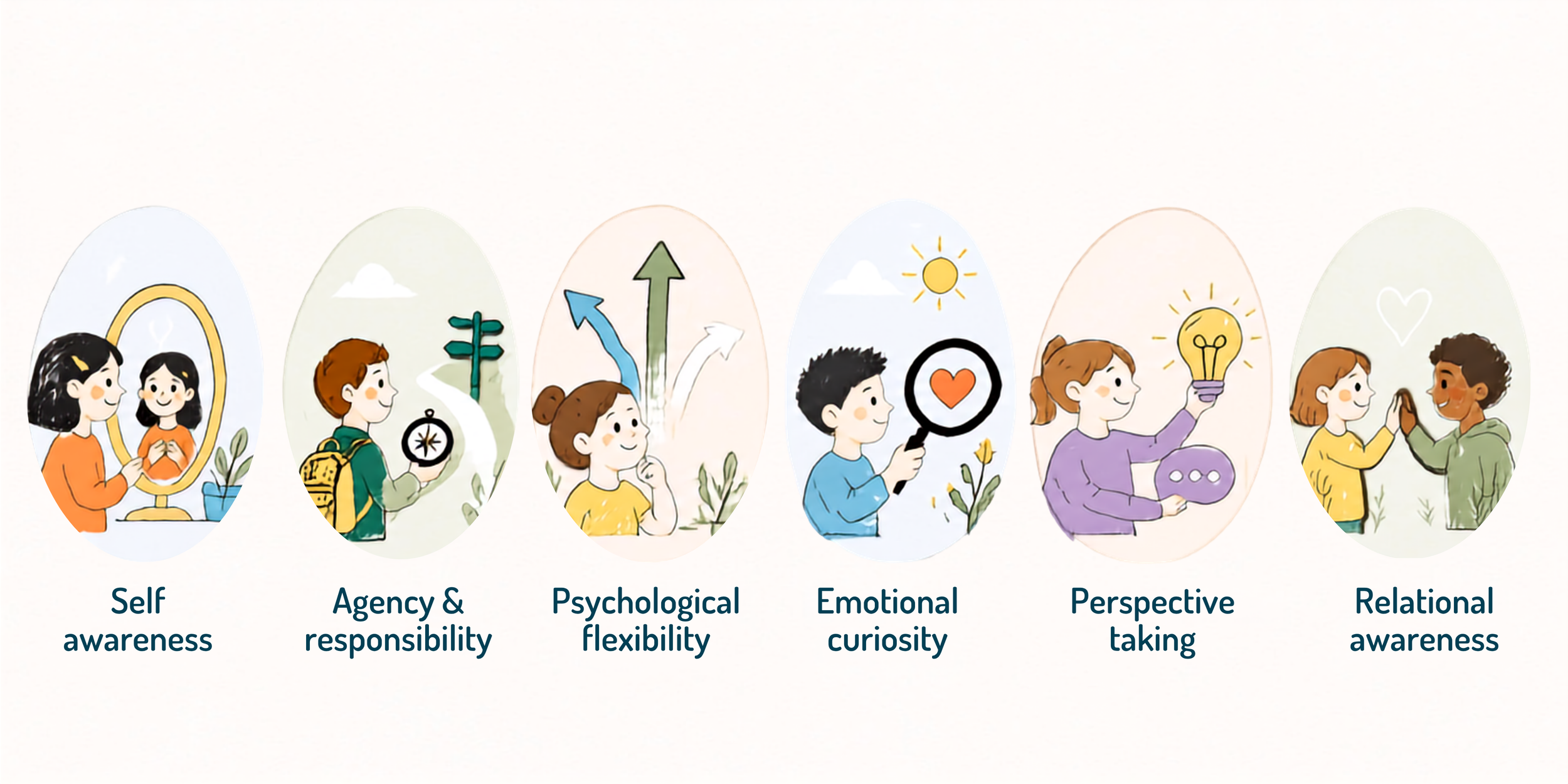
Over the term, children move from noticing me, to understanding me in context, to noticing me with you, and ultimately exploring how we can remain ourselves while making room for one another.
Common Ground is designed as a 10-week, term-based program, with one 45–60 minute session each week.
The school program can be delivered to an individual group or class, or across a year-level cohort, with classroom teachers supporting small-group activities and ordinary classroom management.
Sessions move between whole-group experiments and smaller-group activities, allowing children to experience concepts at scale while still having opportunities for discussion, play and reflection in smaller groups.
The skills developed through these activities function to compliment and enhance existing socio-emotional programs rather than replace or compete with them.
Currently in pilot.
Common Ground commenced its first structured pilot in Term 4, 2026.
The pilot includes child and parent pre/post evaluation, qualitative feedback, attendance and structured facilitator observations. Findings will be used to refine the program ahead of broader school delivery.
Schools interested in 2027 delivery are welcome to enquire now.
If you're responsible for student wellbeing, curriculum or school leadership and would like to explore whether Common Ground could suit your school or setting, you're welcome to get in touch, or book a brief 15-minute conversation below.